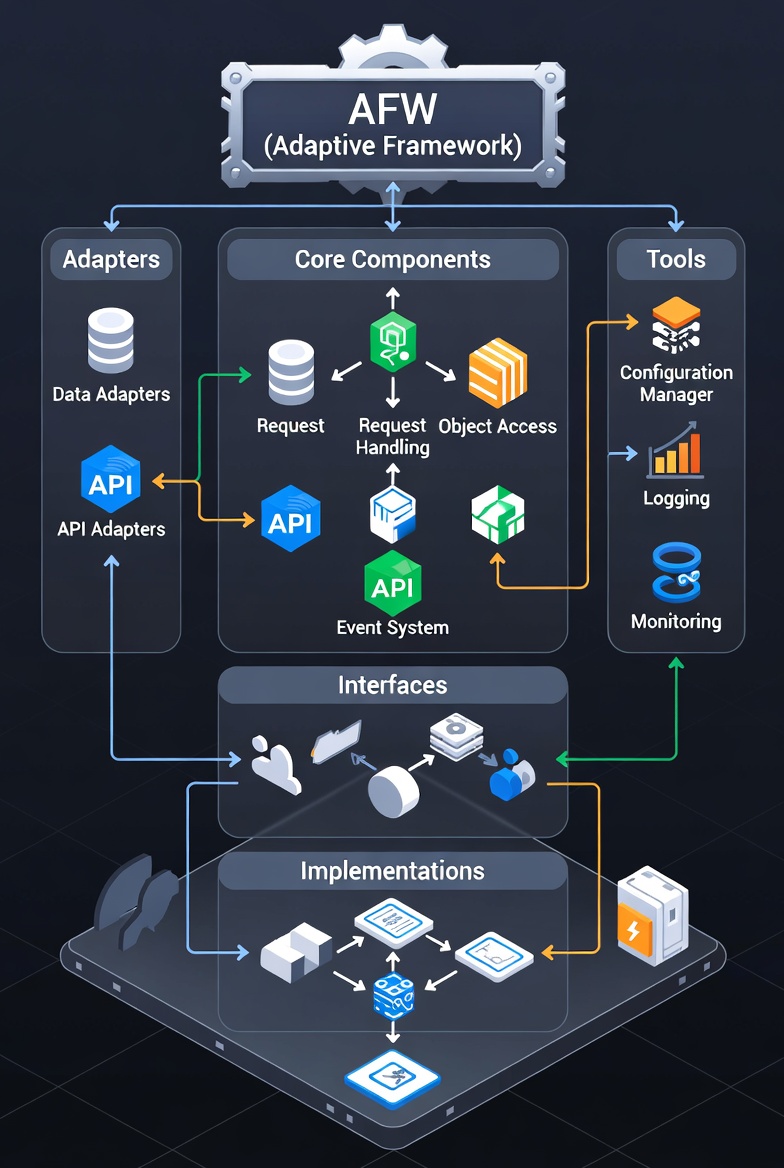

Overview
The Adaptive Framework (AFW) is an innovative open-source project designed to facilitate the creation of flexible, adaptive systems for handling servers, requests, object access, and related components. Developed by the AFW community, AFW aims to provide developers with a set of interfaces, implementations, and tools that promote adaptability in software architecture. It serves as the core framework for innovative projects like projectEureka.ai, demonstrating its maturity and real-world applicability in areas such as AI orchestration and high-performance computing.
Released under a permissive MIT-like license, AFW is hosted on GitHub, with ongoing community contributions to refine its features for broader adoption. In this introductory article, we'll explore the key components of AFW, data types, functions, and object types, and how they interconnect to enable adaptive programming. Whether you're a developer building dynamic servers or an administrator managing complex data environments, understanding AFW's components can unlock new ways to handle variability in your applications.
Background and Community
AFW's roots trace back to a collaborative effort within the open-source community, where it was conceptualized as a tool for adaptive data handling and system integration. The project has gained momentum through community-driven development, resulting in practical applications for data access solutions and beyond.
The framework was recently open-sourced, with documentation available at afw.tools, making it accessible for developers worldwide. AFW includes language bindings (primarily in C), command-line tools, and administrative applications, with comprehensive testing and expanded features supported by the community.
Key Components of the Adaptive Framework
AFW's strength lies in its modular design, which allows components to adapt dynamically based on context, data, or runtime needs. The core elements, data types, function categories, and object types, work together to create a cohesive ecosystem. Here's how they function individually and in tandem.
Data Types: The Foundation of Adaptability
At the heart of AFW are its data types, which define how values are represented, validated, and manipulated within the framework. These types support a wide range of scenarios, from simple primitives to complex structures, ensuring flexibility in data handling.
AFW includes several built-in data types, each tailored for specific use cases. For example:
- Primitive Types: Such as boolean (true/false with string flexibility), integer (whole numbers), and double (64-bit floats supporting INF and NaN).
- String-Based Types: Including string (Unicode sequences), anyURI (URIs with fragments), and specialized formats like dnsName, ipAddress, or rfc822Name (email addresses).
- Temporal Types: date, dateTime, time, and durations like dayTimeDuration or yearMonthDuration, all compliant with ISO 8601 standards.
- Complex Types: list (ordered collections, homogeneous or mixed), object (adaptive objects), function (definitions or references), and expression (adaptive expressions for evaluation).
- Binary Types: base64Binary or hexBinary for encoded data.
These types are "adaptive" because they include built-in validation and conversion rules. This allows AFW to handle data polymorphically, adapting based on context without rigid type casting.
In practice, data types integrate with other components by serving as parameters in functions or properties in objects, enabling seamless data flow across the system.
Function Categories: Operations and Logic
Functions in AFW are organized into categories that provide reusable operations, many of which are polymorphic (i.e., they adapt based on the input type). This categorization makes it easier to build adaptive logic without reinventing common behaviors.
Key function categories include:
- Adapter Functions: For accessing adaptive objects through various adapters, such as databases or external services.
- Administrative Functions: Tools for managing the AFW environment, like configuration and metrics.
- Authorization Functions: Handling access checks, policies, and security decisions, crucial for identity and access management.
- Compiler Functions: Compiling, evaluating, or decompiling adaptive syntax, expressions, or scripts.
- Higher-Order List Functions: Advanced operations on lists, such as mapping, filtering, or reducing.
- Journal Functions: Managing event logs and auditing; these serve as the foundation for an advanced eventing system, enabling real-time notifications, triggers, distributed logging, and event-driven architectures.
- Logical Functions: Boolean operations like AND, OR, NOT.
- Model Functions: Working with adaptive models for data mapping.
- Polymorphic Functions: Generic operations that work across multiple data types.
- Random, Script, Stream, and Value Functions: For generating randomness, scripting, stream handling, and metadata operations.
Functions operate by taking adaptive values (typed data) as inputs and producing outputs that can be chained. For example, an authorization function might evaluate a policy object against a request, using logical functions to determine access.
This component shines in adaptive workflows: A server request might invoke compiler functions to evaluate an expression, then use adapter functions to fetch data, all while logging via journal functions.
Object Types: Structured Entities
Object types in AFW represent structured entities prefixed with "_Adaptive", serving as blueprints for runtime objects. They encapsulate data and behavior, making the framework extensible.
Notable object types include:
- AdaptiveAdapter: Manages connections to data sources.
- AdaptiveAuthorizationControl and AdaptiveAuthorizationResult: For controlling and resulting from access checks.
- AdaptiveConf: Framework configuration objects.
- AdaptiveDataType and AdaptiveFunction: Metadata for data types and functions.
- AdaptiveJournalEntry: Logs events immutably.
- AdaptiveModel: Defines data models.
- AdaptiveObjectType: Base type for all adaptive objects.
- AdaptiveService: Represents services within the framework.
Objects are created and manipulated using functions, with data types defining their properties. For instance, an AdaptiveObject might contain a list of users (using the list data type), and authorization functions could query it to enforce roles.
How the Components Work Together
AFW's components interconnect to form adaptive pipelines. Consider a typical workflow:
- Request Handling: A server receives a request, using administrative functions to load configurations (AdaptiveConf objects).
- Data Processing: Input data is typed (e.g., as dateTime or list), validated, and passed to polymorphic functions for operations.
- Authorization and Access: Authorization functions evaluate policies against object types like AdaptiveAuthorizationHandler, ensuring secure access via adapters.
- Execution and Logging: Compiler functions evaluate expressions or scripts, while journal functions log the process.
- Response: Outputs are serialized back as adaptive values, adaptable to the client's needs.
This modularity allows AFW to scale from simple scripts to complex servers, adapting to changes in data or requirements without major rewrites.
Conclusion
The Adaptive Framework, developed and maintained by the AFW community, offers a promising toolkit for developers seeking flexibility in an ever-changing tech landscape. By understanding its data types, functions, and object types, you can harness AFW to build resilient applications. As the project continues to evolve, expect more integrations and community contributions. For more details, visit the GitHub repository or the official documentation at afw.tools. If you're interested in contributing, the development branch awaits innovative minds!